50 Years of the Sash: Its Place in Crystal Palace History
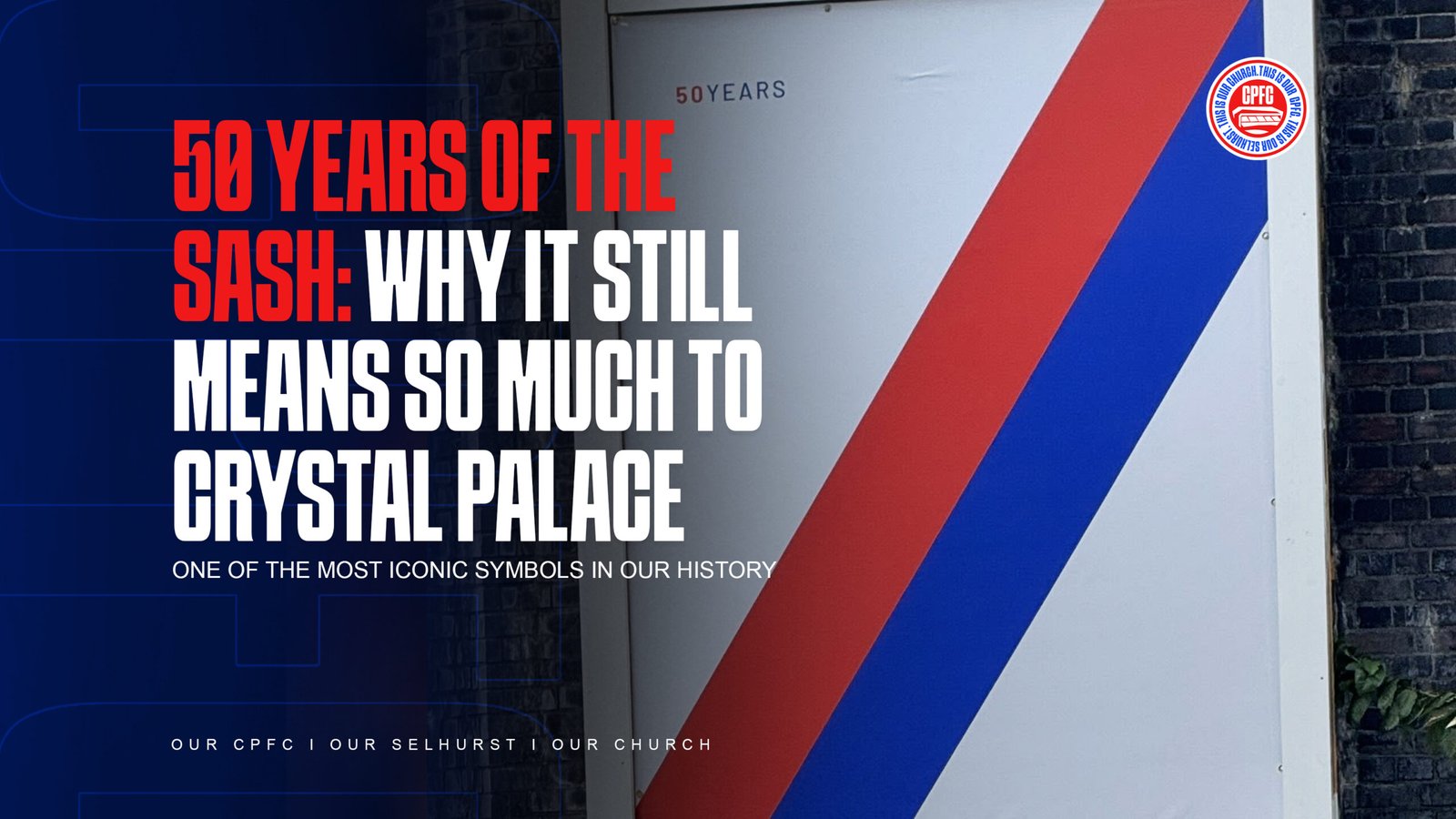
Born during a famous FA Cup victory at Chelsea, carried by one of Palace’s great cup runs and inherited by generations of players and supporters, the sash became much more than a football shirt.
Some football shirts are remembered because of what happened in them, a smaller number become part of the club itself. For us, the sash belongs in that second category.
The design could hardly be simpler. A red and blue diagonal running across a shirt, those two bands of colour carry 50 years of Palace history.
They represent the reinvention of the club under Malcolm Allison. They recall a fearless FA Cup run, the rise of Terry Venables famous ‘Team Of The 80s’.
A NEW IDENTITY
The sash arrived during a revolutionary time for Crystal Palace,
Malcolm Allison took charge in March 1973, Palace were relegated from the First Division shortly afterwards, then suffered another relegation the following season.
The football was moving backwards. Allison responded by trying to make the club look forwards – we went from ‘The Glaziers’ to ‘The Eagles’ – we adopted our badge to match this and we became red and blue, the Crystal Palace we know today.
The rebrand was deliberately bold. Contemporary reports described the new eagle as a symbol of aggression and forward thinking. Palace chairman Ray Bloye said the club wanted a distinctive image which we were lacking prior.
The sash was not introduced by a dominant club celebrating its success. Palace were in the third tier, recovering from consecutive relegations and trying to imagine a more ambitious future.
The shirt projected confidence before the results could justify it.
And that makes it so fitting that we go into this season carrying it yet again (hopefully).
THE SASH WAS BORN
The sash made its first match appearance on 14 February 1976.
Palace travelled to Stamford Bridge to face Chelsea in the fifth round of the FA Cup. Allison’s side were playing in Division Three and entered the match as clear underdogs.
They walked out in white shirts crossed by a red and blue sash – the design created specifically for our FA Cup run.
Then they gave the design an origin story worthy of it.
Palace won 3–2. Taylor had scored twice and created the opening goal. The sash had made its debut during a London cup upset, on Valentine’s Day, in front of a sold-out Stamford Bridge.
It would have been difficult to script a better beginning.

SHIRT OF DREAMS
That Chelsea victory was part of a remarkable FA Cup journey.
Palace had already defeated Leeds United 1–0 at Elland Road. Leeds had contested the European Cup final only months earlier, but Palace played without fear and were worthy winners. After Chelsea came another away victory, this time against Sunderland at Roker Park.
A Division Three Palace side had reached the semi-finals. The run ended with a 2–0 defeat against eventual cup winners, Southampton at Stamford Bridge.
Palace did not reach Wembley. There was no trophy and no perfectly completed story.
The sash did not become the symbol of inevitable success. It became the symbol of possibility.
Palace had travelled to major grounds, beaten supposedly stronger sides and made people believe the club might achieve something extraordinary. The shirt became attached to that feeling.
ALLISON TO VENABLES
Allison resigned after the 1975/76 season. Terry Venables, who had worked alongside him as player-coach and assistant, was appointed manager in June 1976. The sash remained.
Under Venables, Palace won promotion from Division Three in 1977. At the same time, an exceptional group of young players was emerging…
Palace won the FA Youth Cup in consecutive seasons, defeating Everton in 1977 and Aston Villa in 1978. Terry Fenwick scored the decisive goal in both finals.
Those teams included players such as Kenny Sansom, Vince Hilaire, Dave Swindlehurst and Billy Gilbert. Alongside Jim Cannon, John Burridge and others, they helped form the side that became known as the Team of the Eighties.
In May 1979, Palace faced Burnley at Selhurst Park knowing victory would secure promotion and the Second Division title.
More than 51,000 supporters filled the ground.
Ian Walsh opened the scoring before Swindlehurst made it 2–0 late in the match. Six members of Palace’s 1978 Youth Cup-winning side featured that night.
The sash had now become connected to something beyond the excitement of 1976.
Allison had supplied the new identity. Venables and his young players gave it another layer of meaning.

THE SASH AS A SYMBOL
In 2008/09, the sash returned on a white home shirt. That Palace team included Shaun Derry and Paddy McCarthy, as well as a young Nathaniel Clyne making his way into senior football.
Five years later came one of its most popular reinterpretations.
The 2013/14 away shirt placed the red and blue sash across a black background. Supporters came to know it as the evil sash.
It was worn during Palace’s return to the Premier League, a season that began with nine defeats in ten matches but ended with the club in 11th place. Mile Jedinak became the player most closely associated with it, while Dwight Gayle’s late winner at Aston Villa provided one of its defining moments.
The mood was different from 1976. This was not an ambitious cup side announcing itself. It was a promoted team fighting to establish itself in the top division.
EVERYONE HAS A SASH
For some supporters, the sash will always mean Peter Taylor at Stamford Bridge.
For others, it means Sansom, Hilaire and the young Palace side that climbed into the First Division.
A later generation may remember Clyne breaking into the team in 2008/09.
Others will see the black sash and immediately think of Jedinak, Premier League survival and Palace beginning the top-flight run that transformed the modern club.
WHAT’S YOUR SASH?
What is the first Palace sash shirt you remember? And which player, team or match will you always associate with it? Let us know in the Fanzone